
Freelancing gives you freedom, but it rarely gives you certainty. One month you're turning down work; the next, your inbox is empty. That volatility isn't just stressful — it's a real financial risk that compounds over time. The solution most experienced freelancers land on is income diversification: building multiple streams that cover each other's gaps. But not all income types are created equal, and picking the wrong mix can leave you more overwhelmed than before. This guide breaks down the four major categories of freelance income, how each one works, and how to build a portfolio that actually holds together.
Table of Contents
- Active freelance income streams
- Passive and semi-passive freelancing income streams
- Recurring and retainer income streams
- Mixed and hybrid freelancing income streams
- What most freelancers get wrong about income diversity
- Tools to stabilize and track your freelance income
- Frequently asked questions
Key Takeaways
| Point | Details |
|---|---|
| Active vs. passive | Active streams offer short-term security, while passive streams can scale earnings over time. |
| Recurring income matters | Retainer and subscription-based work creates steady income and reduces volatility. |
| Optimal stream count | Three to five quality streams offer the best mix of stability and manageability. |
| Tax essentials | Freelancers must report all income, deduct expenses, and pay quarterly estimated taxes. |
| Balance and tools | Smart tracking and diversification tools are key to maintaining steady freelance income. |
Active freelance income streams
Active income is where most freelancers start, and for good reason. It's the most direct path from skill to paycheck. You do work, you get paid. That simplicity is genuinely valuable, especially when you're building your client base or testing a new niche.
Active income covers any earnings that require your direct, ongoing effort:
- Project-based work: One-time deliverables like a logo, a website, or a research report
- Hourly billing: Charging clients for time spent on tasks, common in consulting and development
- Retainer agreements: A client pays a fixed monthly fee for a set number of hours or deliverables
- Coaching and consulting: Selling your expertise in real time through calls or workshops
The upside is real. Active income gives you direct control over your workload, fast cash flow, and the ability to adjust your rates quickly. When you land a new client, money moves. That immediacy is hard to replicate with other income types.
The downside is equally real. Active income is capped by time — there are only so many billable hours in a week, and burnout is a constant risk when you push that ceiling. Many freelancers also underestimate how much time goes unpaid: client emails, revisions, admin work, and scope creep quietly eat into your effective rate. If you've ever billed 40 hours but worked 60, you already know this problem.
For tax purposes, active freelance income is reported on Schedule C, and you can deduct legitimate business expenses like software, equipment, and a home office. Tracking those deductions matters more than most freelancers realize.
Pro Tip: Before adding new income streams, get clear on what you're actually earning now. Tools for calculating freelance earnings can reveal hidden inefficiencies in your current active work, and real hourly rate examples often show a gap between what you bill and what you keep. Also, watch your client load best practices — spreading yourself too thin is its own kind of income risk.
Passive and semi-passive freelancing income streams
As active work forms the backbone of freelance income, adding passive or semi-passive streams can help stabilize and scale your earnings without simply working more hours.
Passive income, in the freelance context, means revenue that continues flowing after the initial work is done. Semi-passive income requires occasional upkeep but not constant effort. Here's how to build them:
- Online courses: Record your expertise once, sell it repeatedly on platforms like Teachable or Gumroad
- Digital products: Templates, presets, toolkits, or e-books that solve a specific problem for your audience
- Affiliate marketing: Earn commissions by recommending tools or services you already use
- Royalty work: Stock photography, music licensing, or written content that generates ongoing royalties
- Membership communities: Charge a recurring fee for access to your knowledge, feedback, or network
The appeal is obvious. Passive income can scale in ways active work cannot — one course can sell to hundreds of people simultaneously. But the risk is just as real: most passive products need consistent marketing to generate consistent sales. Without promotion, even a great digital product can sit unnoticed.
"Passive income requires upfront investment and ongoing marketing. It's not automatic money — it's deferred labor that pays out over time."
Setup costs for passive streams, including software, design, or platform fees, can often be deducted as business expenses. And just like active income, all earnings are reported on Schedule C with quarterly estimated taxes required.
Pro Tip: Before launching a passive product, validate demand with your existing audience or network. A $50 template that solves a real problem will outsell a $200 course built on assumptions. Also, consider the managing income risks that come with over-relying on passive income before it's proven — and make sure you're not creating avoiding dependency on a single passive channel either.
Recurring and retainer income streams
While passive streams can grow your income, recurring and retainer arrangements offer reliability for freelancers needing steady cash flow. This is often the most underutilized income type, and it's arguably the most powerful for day-to-day financial stability.
Recurring income means a client pays you regularly, usually monthly, for ongoing services. Unlike project work, you know what's coming in before the month starts.
| Stream type | Predictability | Effort level | Scalability |
|---|---|---|---|
| Monthly retainer | High | Medium | Low |
| Maintenance contract | High | Low to medium | Low |
| Content subscription | Medium | Medium | Medium |
| Support package | Medium | Medium | Low |
The benefits go beyond just knowing your income number. Recurring arrangements also smooth your workload, reduce time spent on proposals and pitching, and build deeper client relationships over time.
The risks are worth knowing too:
- Scope creep: Clients in retainer relationships sometimes expand what they expect without adjusting the fee
- Restrictive commitments: Long contracts can lock you in when better opportunities arise
- Complacency: Guaranteed income can reduce the urgency to keep improving or marketing
Recurring income helps stabilize cash flow and workload in ways that project-based work simply cannot. The key to making retainers work is defining deliverables clearly upfront. Vague agreements are where scope creep starts.
Good income tracking tips help you spot when a retainer is costing you more in time than it's paying. And if you've ever had a client who simply stops paying, understanding how to handle avoiding unpaid work is essential to protecting your recurring revenue.
Mixed and hybrid freelancing income streams
Bringing together multiple streams creates a safety net — let's see how to design a hybrid freelance income portfolio that actually works.
A hybrid approach means deliberately combining active, passive, and recurring income so that each stream compensates for the weaknesses of the others. When a project client goes quiet, your retainer keeps the lights on. When your retainer client pauses, a digital product sale covers the gap.

| Income type | Stability | Scalability | Time cost | Best for |
|---|---|---|---|---|
| Active (project) | Low | Low | High | Fast cash, new niches |
| Active (retainer) | Medium | Low | Medium | Reliable base income |
| Passive (digital) | Variable | High | Low (after setup) | Long-term scaling |
| Recurring (contract) | High | Low | Low to medium | Predictable planning |
The optimal mix, according to income diversification research, is three to five well-chosen streams. More than that and you risk spreading your attention too thin, letting quality slip across the board.
Here's how to build a sustainable hybrid portfolio:
- Start with one strong active stream that covers your baseline expenses
- Add one recurring arrangement to reduce month-to-month volatility
- Develop one passive product that aligns with your existing expertise
- Evaluate each stream quarterly: is it paying off relative to the time it takes?
- Use income stability tools to track performance across streams
The biggest mistake freelancers make is adding streams reactively, chasing whatever looks profitable in the moment. A hybrid portfolio works when it's designed, not when it's accumulated by accident. Also, watch for burnout prevention advice — managing multiple streams has a real cognitive cost that compounds fast.
What most freelancers get wrong about income diversity
Here's the uncomfortable truth: more income streams don't automatically mean more stability. We've seen freelancers juggling six or seven streams who are more financially anxious than someone with two well-managed ones. The problem isn't the number — it's the mental load.
Every income stream you add is a small business inside your business. It needs attention, promotion, client management, or upkeep. When you spread across too many, none of them get the focus they need to perform well. Quality streams outperform scattered hustle — and that's not just a financial observation. It's an emotional one.
Stability isn't only about how much money comes in. It's about how predictable and manageable your work life feels. A freelancer with three reliable, well-understood income streams sleeps better than one chasing ten unpredictable ones. The emotional cost of freelance income instability is real, and it rarely shows up in income calculators.
Our take: build fewer streams, but build them well. Choose income types that align with how you actually work, not just what looks good on paper. Durability beats novelty every time.
Tools to stabilize and track your freelance income
Now that you know how to choose and balance income streams, the next step is tracking and optimizing what you've built. Knowing your income types is one thing — knowing how each one actually performs is another.
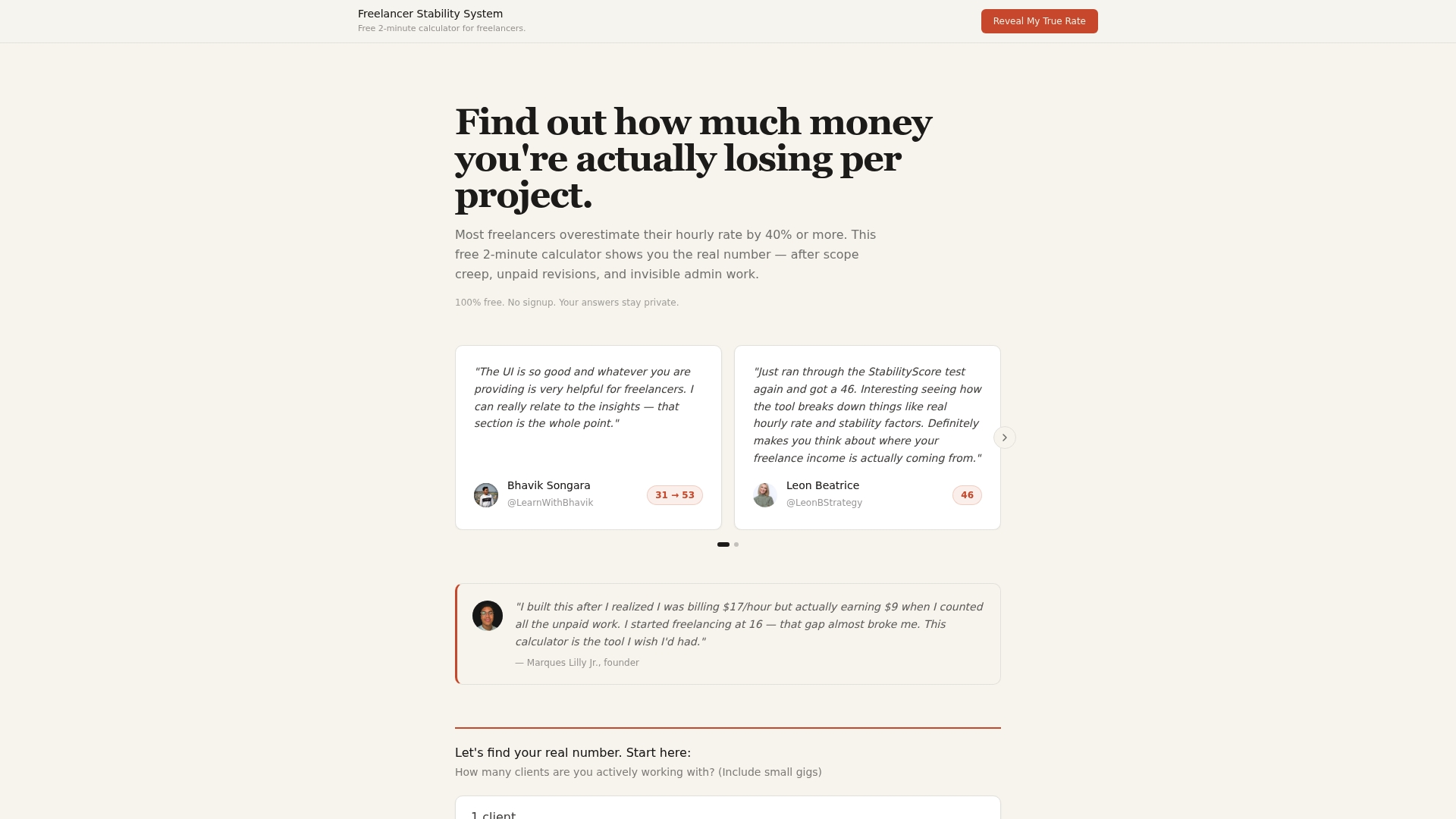
StabilityScore.app gives you free tools to do exactly that. The income equation calculator shows what you're really earning after unpaid hours, revisions, and admin time are factored in. The emotional cost guide helps you understand the hidden toll of income volatility. Together, these resources help you move from guessing to knowing — and from reacting to planning. It takes about two minutes to get started, and the clarity it provides is worth far more than that.
Frequently asked questions
Which freelancing income types are most stable?
Recurring and retainer streams offer the most consistent earnings for freelancers, reducing cash flow volatility by providing predictable monthly income.
How many income streams should a freelancer aim for?
Three to five streams is the optimal range — quality and manageability matter far more than simply having a high number of sources.
What are the main tax considerations for freelance income?
All freelance income types are reported on Schedule C, business expenses are deductible, and quarterly estimated taxes apply regardless of income source.
Is passive freelancing income really passive?
Not entirely — passive income requires real upfront work and ongoing marketing to generate consistent results, but it can become low-maintenance once established.
How can freelancers track and optimize their income streams?
Using platforms like StabilityScore.app helps you visualize, track, and improve the balance of your income streams using free, practical tools built for independent workers.