
You invoice $4,000 for a project, feel good about it, then realize after platform fees, unpaid revision hours, and a two-week payment delay, you actually netted closer to $2,100. That moment of shock is something most freelancers know well. Income gaps are not just about slow months or bad clients. They hide in your daily workflow, your pricing habits, and your time. This guide walks you through a clear, repeatable process to find exactly where your money is disappearing and what you can do to close those gaps for real, lasting financial stability.
Table of Contents
- Understanding income gaps for freelancers
- What you need before gap analysis: prep and tools
- Step-by-step: How to identify your income gaps
- Confirming and closing the gap: tracking and adjustments
- A hard truth: Identifying income gaps is the easy part
- Take control of your freelance income
- Frequently asked questions
Key Takeaways
| Point | Details |
|---|---|
| Income gaps are common | Many freelancers earn less than expected due to hidden expenses, underpricing, and unpaid work. |
| Track and analyze monthly | Consistent income and expense tracking reveals hidden gaps and volatility. |
| Proper tools matter | Using financial tracking tools helps you see your true earnings and spot red flags faster. |
| Close gaps with action | Raising rates, managing expenses, and filling unpaid hours are key to achieving stability. |
Understanding income gaps for freelancers
An income gap is the difference between what you expect to earn and what actually lands in your account after all costs and unpaid time are factored in. For freelancers and gig workers, this gap is rarely obvious. It builds quietly over weeks and months, shaped by decisions that seem small in the moment.
The most common sources of income gaps include:
- Underbilling: Charging less than your time and expertise are worth
- Platform fees: Marketplaces and payment processors that take a cut of every transaction
- Non-billable hours: Admin work, client emails, proposals, and revisions you never invoice for
- Scope creep: Projects that expand beyond the original agreement without extra pay
- Payment delays: Waiting 30 to 60 days to get paid while your expenses keep running
The numbers behind this are striking. 57% of US gig workers experience income volatility, and 40% earn less than $15 per hour after expenses. That is not just a financial problem. It is a planning problem. When you cannot predict your income, you cannot plan your spending, your savings, or your growth.
| Gap source | Average impact | Visibility |
|---|---|---|
| Platform fees | 5 to 25% of revenue | Easy to see |
| Non-billable hours | 10 to 30% of time | Hard to see |
| Scope creep | 15 to 40% extra work | Often invisible |
| Payment delays | 2 to 8 weeks cash lag | Moderate |
| Underpricing | Varies widely | Very hard to see |
The psychological toll of not knowing your real income is just as damaging as the financial loss. Anxiety, overworking, and poor decisions around client selection all trace back to unclear numbers. Learning to track income volatility gives you a foundation to work from instead of guessing.
"The first step to fixing your finances is knowing exactly what you are working with. Most freelancers skip this step entirely."
Understanding the freelancer income equation means looking at gross revenue minus every cost, including your time. Once you see the full picture, you can start making smarter decisions about which projects to take, how to price them, and where to push back on clients. That clarity is where stability begins.
For a broader look at managing unpredictable cash flow, budgeting for irregular income is a practical starting point that many freelancers overlook until things get tight.
What you need before gap analysis: prep and tools
Before you can identify your income gaps, you need the right data in front of you. Trying to analyze your finances without organized records is like trying to navigate without a map. You might get somewhere, but it will take much longer and you will miss a lot.
Here is what to gather before you start:
- 12 months of income records: Bank statements, invoices paid, and platform payouts
- Expense records: Software subscriptions, equipment, taxes, professional fees
- Time logs: How many hours you actually worked per project, including unpaid time
- Payment delay records: How long clients typically take to pay after invoicing
- Platform fee summaries: Any percentage taken by Upwork, Fiverr, PayPal, Stripe, or similar services
The tool you use matters less than the habit of using it consistently. A spreadsheet works fine. Accounting software like FreshBooks or QuickBooks adds automation. Even a notebook with monthly summaries beats nothing.
| Tool type | Best for | Cost |
|---|---|---|
| Spreadsheet | Full control, custom setup | Free |
| Accounting software | Automation, tax prep | $15 to $50/month |
| Freelancer platforms | Built-in invoicing | Varies |
| StabilityScore.app | Real hourly rate, gap analysis | Free |
One of the most important habits you can build is separating your business and personal accounts. Separate business and personal accounts and review them monthly to clarify your true earnings. When everything runs through one account, it is nearly impossible to see what the business actually costs you.
You also need a comparison-ready summary. This means having your average monthly income, your average monthly expenses, and your average monthly hours all in one place. Without that side-by-side view, gaps stay hidden. Many freelancers are surprised to discover real income discrepancies when they finally run the numbers this way.

Pro Tip: Always use conservative income estimates when building your baseline. Use your three lowest-earning months, not your best ones. This protects you from overestimating stability and helps you plan for the reality of freelance income, not the highlight reel.
Step-by-step: How to identify your income gaps
With your data organized, you are ready to run the actual analysis. This process works whether you are a full-time freelancer or picking up gig work on the side.
-
Calculate your conservative monthly income average. Add up your total income for the past 12 months and divide by 12. Then subtract 10 to 15% to account for your slowest periods. This is your working baseline.
-
List every fixed and variable expense. Fixed costs include software, insurance, and subscriptions. Variable costs include project-specific tools, contractor payments, and marketing spend. Total these monthly.
-
Subtract platform fees from gross revenue. Platform fees up to 25% are common in gig work, and hourly rates often lag behind inflation unless you specialize. If you earned $3,000 on a platform that charges 20%, your real starting point is $2,400 before any other expenses.
-
Account for non-billable time. Log every hour you worked last month, then separate billable from non-billable. Divide your net income by total hours worked, not just billable ones. This gives you your real hourly rate.
-
Check for scope creep and underbilling. Review your last five projects. Did any run longer than quoted? Did you add features, revisions, or meetings without charging? These are direct income leaks. Understanding unpaid hours and scope creep is one of the fastest ways to recover lost income.
-
Benchmark your rates. Compare your real hourly rate to industry averages for your specialty and experience level. If you are below the median, that gap is a pricing problem, not a market problem.
-
Note the gap. Write down the difference between what you expected to earn and what you actually netted. That number is your income gap. It is also your target for improvement.
Pro Tip: Use a single project as a test case first. Run through all seven steps for one recent project and calculate exactly what you earned per hour. The result is usually eye-opening and motivates the full analysis.
Learning to approach pricing without guessing is what turns this one-time exercise into a long-term habit that protects your income.
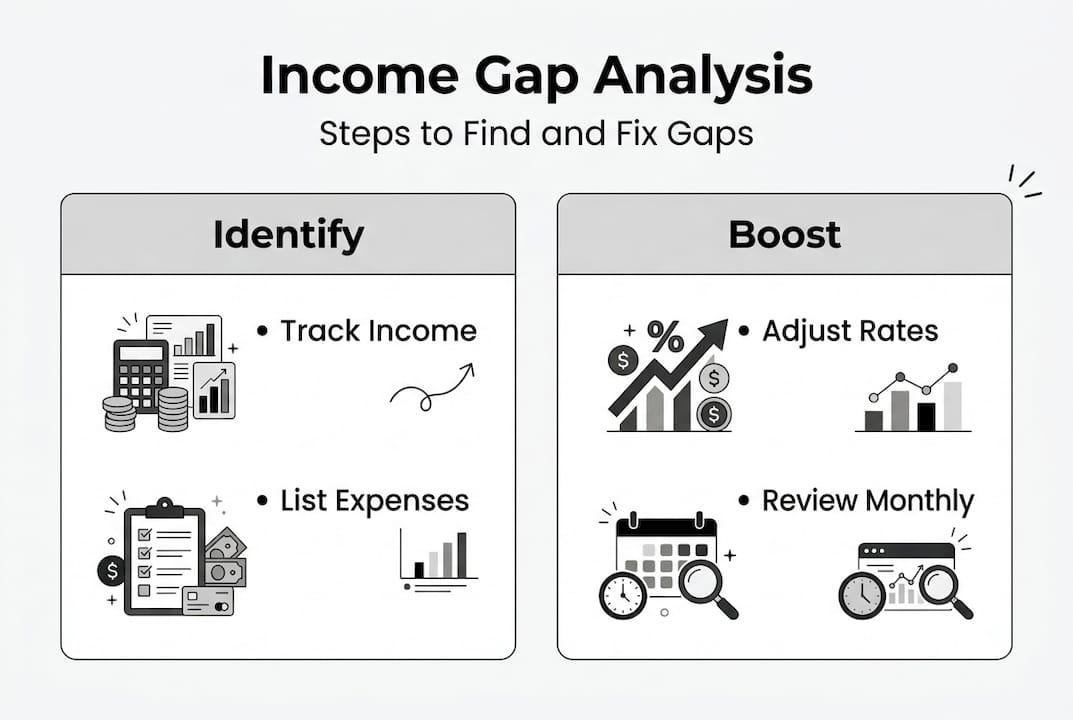
Confirming and closing the gap: tracking and adjustments
Finding your income gaps is only useful if you act on them. The next step is confirming those gaps with ongoing data and making targeted changes that actually stick.
Here are the quick wins that move the needle fastest:
- Raise your rates on new projects by 10 to 20% and track whether client conversion drops
- Add a scope change clause to every contract so extra work is automatically billable
- Set a minimum project size to filter out low-value clients that consume disproportionate time
- Start an emergency fund with a target of three months of your conservative baseline income
- Block one hour per month for a financial review, treating it like a client meeting you cannot cancel
| Adjustment | Impact timeline | Difficulty |
|---|---|---|
| Raise rates | 1 to 2 months | Medium |
| Add scope clauses | Immediate | Low |
| Cut low-value clients | 2 to 3 months | High |
| Build emergency fund | 6 to 12 months | Medium |
| Monthly reviews | Ongoing | Low |
The most common mistakes freelancers make after identifying gaps are not updating their expense tracking when costs change, underestimating how much unpaid time they spend on client communication, and reviewing their finances too infrequently to catch new gaps before they grow.
Specialization, regular income reviews, emergency savings, and prioritizing essentials are the four pillars that consistently help freelancers buffer volatility and close income gaps over time.
"Tracking without adjusting is just record-keeping. The goal is to use what you find to make better decisions next month."
Building financial resilience takes time, but each monthly review compounds. After three months of consistent tracking, most freelancers can predict their income within 15% accuracy. After six months, they start turning down projects that do not meet their real hourly rate threshold. That is when the gap starts closing for good. Use a calculator to calculate your real hourly rate and make this a regular checkpoint in your workflow.
A hard truth: Identifying income gaps is the easy part
Here is something most financial guides skip: the math is the easy part. Running the numbers takes an afternoon. The hard part is sitting with what those numbers tell you, especially when they reveal that a long-term client is actually your worst earner, or that your "good month" was mostly a cash flow illusion.
Most freelancers who try income gap analysis once do not repeat it. Not because it did not work, but because it surfaces uncomfortable truths. Facing the reality of income stability challenges requires more than a spreadsheet. It requires honesty about your pricing, your client relationships, and your working habits.
The freelancers who actually close their gaps share one trait: they review their numbers even when the numbers are bad. Especially when the numbers are bad. They also learn to avoid client dependency by diversifying their income sources before they need to, not after a major client disappears.
Consistency beats precision here. A rough monthly review done every month is worth ten times more than a perfect annual audit you never finish. Build the habit first, then refine the process.
Take control of your freelance income
You have done the analysis. Now make it work for you over the long term. StabilityScore.app gives you free tools designed specifically for freelancers who want to stop guessing and start knowing.
Use the calculator to see your real hourly rate after accounting for unpaid hours, scope creep, and overhead. Then analyze your income leakage to find exactly where your revenue is slipping away. If the financial stress of inconsistent income is weighing on you, the resources to manage income stress offer practical guidance from people who understand what freelance financial pressure actually feels like. Your next step is one click away.
Frequently asked questions
What is an income gap for freelancers?
An income gap is the difference between what you expect to earn and your actual take-home pay, after all expenses and unpaid time are accounted for. For many freelancers, this gap is larger than expected once platform fees and non-billable hours are included.
How often should I review my freelance income for gaps?
Monthly reviews are best to catch volatility and spot income gaps early, especially if your projects vary or you have inconsistent clients. Regular monthly reviews are considered essential for freelancers with variable income.
Which tools help identify income gaps for gig workers?
Spreadsheets, freelancer accounting software, and specialized platforms like StabilityScore.app help you track true earnings and spot hidden gaps. Specialized platforms make income tracking easier and more consistent for independent professionals.
How can I close my freelance income gaps?
Increase rates, cut unnecessary expenses, fill unpaid time with paid projects, and build an emergency fund to buffer volatility. Emergency savings and prioritizing essentials are two of the most reliable strategies for closing gaps over time.